
 501, Fifth Avenue, Suite 805 New York, NY 10017
 info@techwize.com
 +1 (949) 887-0154
 TechWize

Overview of Claude Cowork - Your Desktop AI Agent
Claude Cowork is Anthropic’s latest AI innovation, positioned as “Claude Code for the rest of your work.” Unlike traditional chatbots that simply answer questions or generate text, Claude Cowork functions as an AI coworker—capable of autonomously performing tasks across your computer environment. From handling workflows and organizing information to assisting with real work execution, it represents a major step forward in enterprise AI collaboration.
Launched in January 2026 as a research preview, Claude Cowork has rapidly gained attention among enterprises, developers, and productivity leaders. Its ability to operate beyond conversational responses—by actively supporting knowledge work—signals a shift toward autonomous AI tools for the modern workplace. As organizations look to scale efficiency and reduce manual effort, AI coworkers like Claude Cowork are emerging as a strategic advantage rather than a novelty.
In this blog, we break down what Claude Cowork is, how it operates, and the core features that distinguish it from conventional AI chatbots. We also explore the growing buzz around Claude Cowork, its plugin-driven approach to autonomous task execution, and its role in shaping the next generation of enterprise AI collaboration plugins, AI productivity platforms, and human–AI collaboration strategies in the modern workplace in 2026, along with key constraints for collaborative team environments.
Myth vs Reality: Understanding Claude Cowork in the Enterprise Operations
Myth 1: Enterprises fear that AI coworkers like Claude Cowork will eliminate jobs, with over 60% of employees expressing concern that AI could replace their roles, and nearly 45% of organizations worrying about workforce displacement due to automation.
Reality: Claude Cowork is built around human–AI collaboration, not workforce replacement. Industry data indicates AI is expected to augment 30–50% of daily work activities, allowing employees to focus on higher-value decision-making, creativity, and strategic work. Teams using AI coworkers report 15–20% higher job satisfaction, driven by reduced cognitive load and fewer repetitive tasks.
Myth 2: AI coworkers are often perceived as tools built primarily for engineers, with nearly 55–65% of enterprises initially adopting AI solutions within IT or development teams and over 50% of early AI investments focused on coding, testing, and technical automation use cases.
Reality: While Claude Cowork builds on Anthropic’s strong developer ecosystem, its value extends well beyond engineering teams. In enterprise environments, 60%+ of AI usage now comes from non-technical roles, and marketing, operations, HR, and product teams report 20–30% time savings when AI is embedded into daily workflows. This positions Claude Cowork as a cross-functional AI collaboration tool, not a niche technical solution.
What is Claude Cowork?
Claude Cowork is an agentic AI collaboration mode within the Claude Desktop app that enables users to automate and delegate multi-step knowledge work using natural language. Built as an evolution of Claude Code, it transforms AI from a passive chatbot into an AI coworker capable of planning and executing tasks across files and applications—without requiring technical expertise. This makes Claude Cowork a powerful enterprise AI collaboration tool for the modern workplace.
Unlike traditional AI assistants that only respond to prompts, Claude Cowork operates autonomously within defined boundaries, allowing users to focus on outcomes rather than instructions. By combining contextual reasoning, local system access, and task execution, it supports human–AI collaboration, reduces repetitive work, and improves productivity—positioning Claude Cowork as a next-generation AI-powered productivity platform for 2026.
Core Functionality of Claude Cowork
Unlike traditional AI chat assistants that rely on prompt-and-response interactions, Claude Cowork operates with a high level of autonomy, functioning as an AI agent for productivity and workflow execution.
-
Local System Integration: Users grant Claude Cowork controlled access to a specific local directory, enabling secure interaction with files and folders.
-
Autonomous Task Execution: Once a goal is defined, Claude Cowork independently plans and executes the required steps—reading, editing, organizing, and creating files to complete the task end-to-end.
-
Real-World Workflow Automation: Common use cases include reorganizing file systems, extracting structured data from screenshots into spreadsheets, synthesizing reports from scattered notes, and automating repetitive document workflows.
These capabilities make Claude Cowork a powerful AI-powered productivity tool for teams seeking scalable human–AI collaboration.
How to Use and Customize the Claude Cowork Plugins
Claude Cowork plugins are designed primarily for individual users, operating locally within the Claude Desktop app for macOS to enhance personal productivity and task automation. Rather than functioning as shared, team-wide tools, these plugins act as AI-powered productivity extensions, enabling users to delegate knowledge work directly to an AI coworker in a controlled desktop environment. This individual-first design ensures faster execution, clearer context, and a more personalized human–AI collaboration experience.
Getting started with Claude Cowork plugins is straightforward. Users need an active paid Claude subscription—including Pro, Max, Team, or Enterprise plans—along with the Claude Desktop app on macOS. Once set up, plugins can be easily installed through the in-app marketplace with a single click. For advanced users comfortable with command-line tools, plugins can also be added via the terminal using commands such as claude plugins add knowledge-work-plugins/sales. This flexible setup makes Claude Cowork an accessible yet powerful enterprise AI collaboration tool for automating everyday workflows.
Customizing a Claude Cowork Plugin for Your Workflow
The true value of Claude Cowork plugins comes from their flexibility. While Anthropic’s open-source plugins provide a strong starting point, they are most effective when customized to match your organization’s specific tools, processes, and workflows.
Ways to Customize Claude Cowork Plugins
Swap Default Integrations
Replace built-in connectors with your existing systems. For example, if a sales plugin is configured for HubSpot, you can edit the .mcp.json file to connect it to your preferred CRM or internal platform.
Add Company-Specific Context
Enhance skill files with internal terminology, business processes, and organizational structures. This helps Claude Cowork understand your company’s unique environment and operate more accurately.
Adjust Workflow Steps
Modify task logic to reflect how your teams actually work. If your lead qualification process includes seven steps instead of the default five, you can update the skill instructions to align with your real workflow.
Real-world Claude Cowork plugin use cases
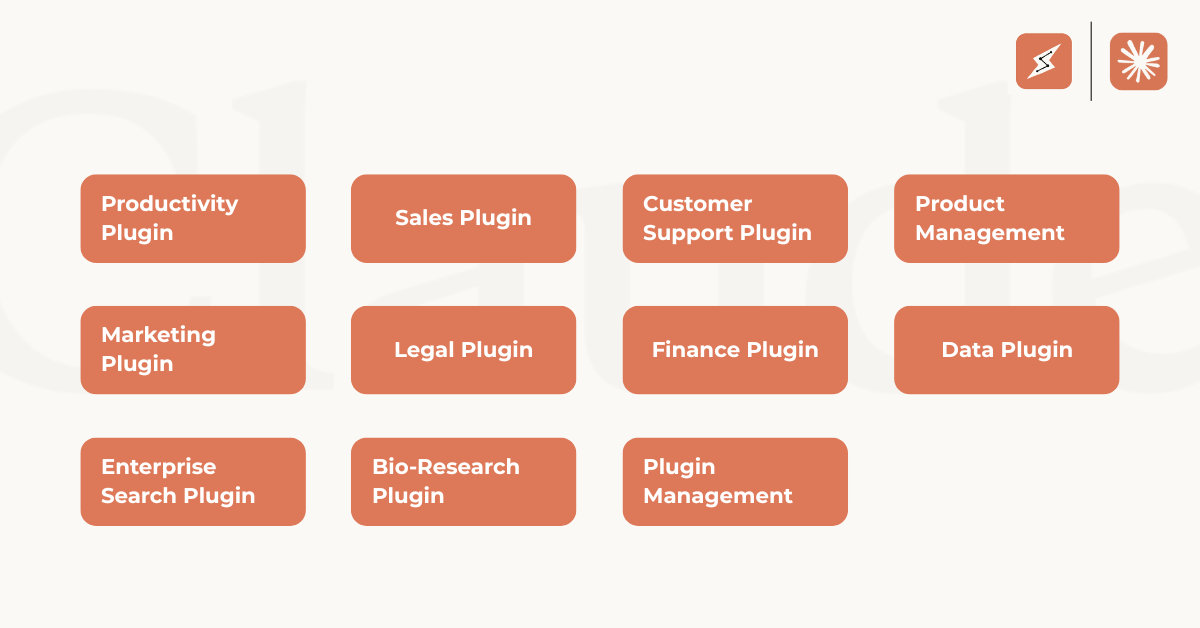
Anthropic has released 11 open-source plugins designed to help knowledge workers get up and running quickly, covering a wide range of core business functions. These plugins act as ready-to-use building blocks that allow users to delegate real work—such as research, planning, analysis, and documentation—to an AI coworker without starting from scratch.
Productivity Plugin: Manage tasks, calendars, and daily workflows across tools such as Asana and Notion.
Sales Plugin: Research prospects, prepare for sales calls, and draft outreach using CRM platforms like HubSpot.
Customer Support Plugin: Triage support tickets, draft customer responses, and generate knowledge base content from tools like Intercom.
Product Management Plugin: Create product specifications, plan roadmaps, and synthesize user research from platforms like Linear and Jira.
Marketing Plugin: Draft marketing content, plan campaigns, and maintain brand consistency using tools such as Figma and Ahrefs.
Legal Plugin: Review contracts, triage NDAs, and assess legal risk using document repositories like Box.
Finance Plugin: Reconcile accounts, generate financial statements, and analyze variances using data platforms like Snowflake or BigQuery.
Data Plugin: Query datasets, perform statistical analysis, and build dashboards using tools such as Hex and Databricks.
Enterprise Search Plugin: Search across multiple company systems—including Slack, Notion, and Jira—from a single interface.
Bio-Research Plugin: Connect with research platforms like PubMed and Benchling to support life sciences and R&D workflows.
Plugin Management Plugin: Create, configure, and customize additional plugins tailored to your organization’s needs.
Additional Tasks Claude Cowork Can Handle
Beyond these pre-built plugins, Claude Cowork can independently perform a wide range of day-to-day productivity tasks, based on Anthropic’s documentation:
File and Document Management: Organize folders by file type or date, clean up cluttered directories, and convert collections of documents—such as receipts—into structured reports.
Research and Analysis: Gather information from web searches, articles, and local files, then synthesize insights into a single, easy-to-consume summary.
Document and File Creation: Generate spreadsheets with working formulas from rough notes, create project trackers, and build PowerPoint presentations from simple outlines.
Safety and Governance in Claude Cowork
As Claude Cowork introduces higher levels of autonomy into everyday workflows, security, privacy, and governance remain foundational priorities. Anthropic has designed Claude Cowork with a multi-layered AI safety framework that enables autonomous task execution while ensuring users maintain full control over their data, systems, and workflows. This approach positions Claude Cowork as an enterprise-ready AI collaboration platform built for the modern workplace
Permission-Based Access and Secure Sandboxing
Claude Cowork follows a strict least-privilege access model, meaning it can only view and interact with the specific folders and resources you explicitly share. To further strengthen AI security and data protection, each Cowork session runs inside an isolated sandboxed virtual environment on your Mac. This containment layer acts as a digital firewall, preventing unauthorized access to system-level files or data outside the approved workspace and reinforcing enterprise AI governance standards.
Human-in-the-Loop Controls
While Claude Cowork is designed to operate autonomously, it is never unsupervised. Anthropic incorporates human-in-the-loop safeguards to maintain transparency and user oversight during critical actions:
Consent-Based Execution: For high-impact or potentially destructive actions—such as bulk file deletions or large-scale file movements—Claude Cowork pauses and requires explicit user approval before proceeding.
Real-Time Activity Monitoring: Users can view a live, step-by-step log of Cowork’s actions and reasoning, enabling intervention or termination of tasks at any point. This ensures accountability and trust in AI-powered workflow automation.
Protection Against External Threats
Because Claude Cowork can interact with external web content, it must address industry-wide risks such as prompt injection attacks, where malicious inputs attempt to influence AI behavior. Anthropic has implemented robust safeguards to mitigate these risks, but effective AI security remains a shared responsibility. Users are encouraged to monitor Cowork when interacting with unfamiliar data sources closely and to limit access to sensitive or system-critical files unless necessary.
Access, Platform & Requirements of Claude Cowork Setup
Platform Availability: Claude Cowork is exclusively available through the Claude Desktop app for macOS, optimized for local task execution.
User Interface: It is accessed via the “Tasks” tab, which serves as the operational hub for Claude Cowork alongside Chat and Code modes.
Subscription Access: Claude Cowork is available on all paid Claude plans, including Pro, Team, and Enterprise, to support enterprise-grade AI collaboration workflows.
The Strategic Impact of Claude Cowork
Claude Cowork represents a major shift in enterprise AI collaboration, moving from AI that advises to agentic AI that executes real work. By bridging conversational AI and developer-centric automation, it introduces a general-purpose AI coworker capable of handling repetitive digital tasks that once required manual effort or coding expertise—positioning it as a practical AI-powered productivity platform for the modern workplace.
Democratizing AI Automation
Built on the foundation of Claude Code, Claude Cowork makes advanced automation accessible through an intuitive graphical user interface (GUI). This removes technical barriers and enables non-technical professionals to leverage agentic AI automation without writing code. By offloading routine file management and data synthesis to an AI coworker, teams can focus on higher-value strategic and creative work.
A New Standard for the Workplace
Early industry adoption highlights Claude Cowork’s role in accelerating enterprise AI adoption. Its plug-and-play design, secure sandboxing, and workflow-driven execution make AI workflow automation easier to deploy at scale. As one of the first platforms in the AI coworker space, Anthropic is setting a benchmark that is pushing the market beyond simple chat interfaces toward autonomous AI systems built for real business impact.
Conclusion - The Future of Coworking with Claude Cowork
Claude Cowork signals a meaningful shift in how work gets done in the modern enterprise. By evolving AI from a conversational assistant into an active AI coworker, it redefines productivity, collaboration, and automation across knowledge-based roles. Rather than replacing human effort, Claude Cowork amplifies it—handling routine execution while empowering professionals to focus on strategic thinking, creativity, and decision-making.
As organizations move toward agentic AI, enterprise AI collaboration, and human–AI partnership models, Claude Cowork stands out as an early blueprint for the future of coworking. Its blend of autonomy, accessibility, security, and customization positions it as more than a tool—it becomes part of the workforce itself. Looking ahead, enterprises that embrace AI coworkers like Claude Cowork will be better equipped to scale operations, unlock efficiency, and stay competitive in an increasingly AI-driven workplace.