501, Fifth Avenue, Suite 805 New York, NY 10017
 info@techwize.com
 +1 (949) 887-0154
 TechWize

A few years ago, ChatGPT, Claude, and Gemini introduced the world to the capabilities of large language models in a conversational interface. Today, that novelty has evolved into something far more consequential for business: autonomous, task-executing AI agents. Enterprises no longer want a tool that simply answers questions - they want systems that can reason through a problem, pull data from internal systems, take action, and hand back a completed task.
This shift has turned Enterprise AI Agent Development from an experimental IT project into a core business investment. Companies across finance, healthcare, retail, and logistics are moving beyond pilot programs to build production-grade AI agents that plug directly into their operations. But getting there requires more than access to a powerful model. It requires a structured, secure, and scalable development approach - which is exactly what this guide walks you through.
What Is Enterprise AI Agent Development?
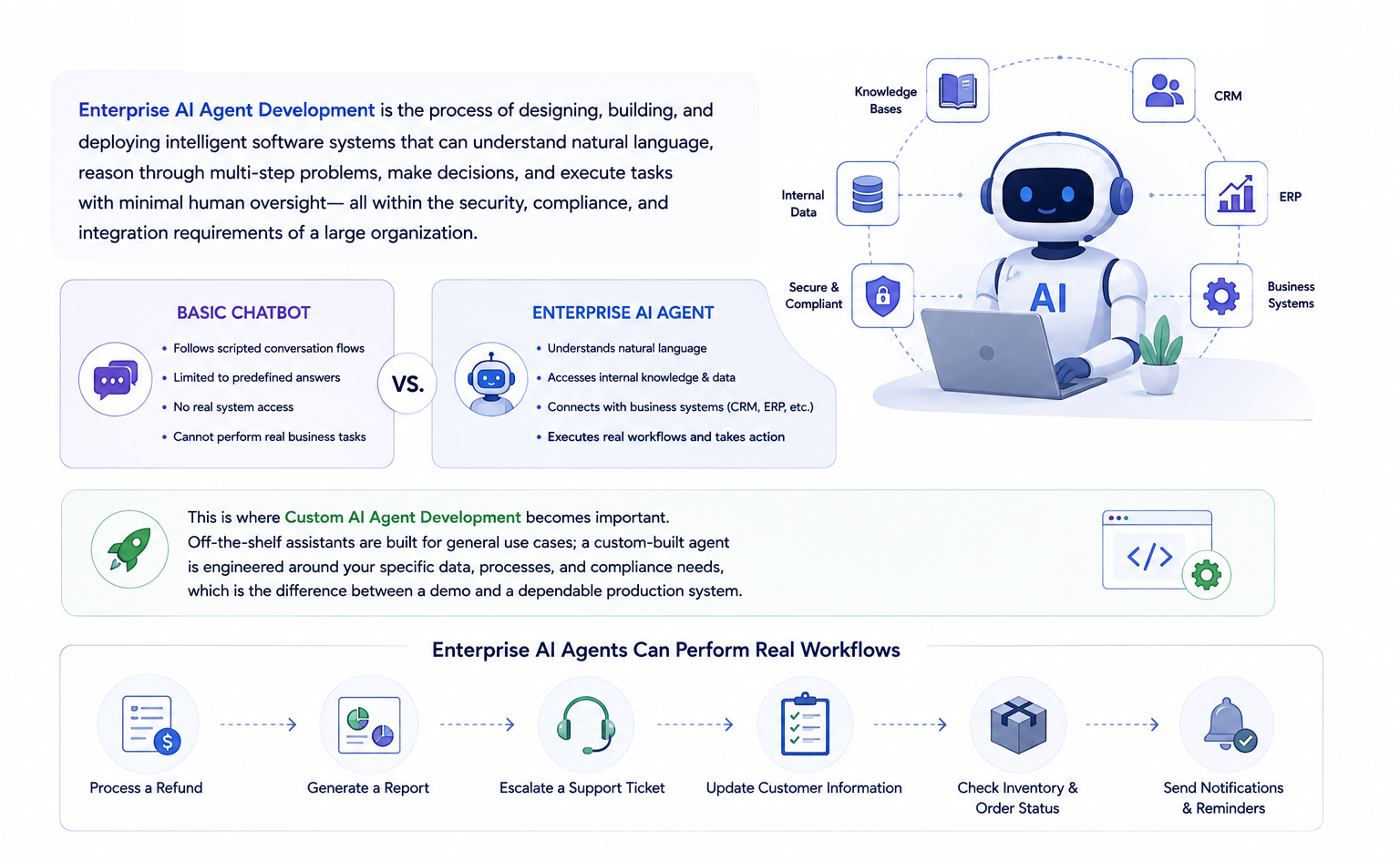
Enterprise AI Agent Development is the process of designing, building, and deploying intelligent software systems that can understand natural language, reason through multi-step problems, make decisions, and execute tasks with minimal human oversight - all within the security, compliance, and integration requirements of a large organization.
Unlike a basic chatbot that follows scripted conversation flows, an enterprise AI agent can access internal knowledge bases, connect with business systems such as CRM and ERP platforms, and perform real workflows, such as processing a refund, generating a report, or escalating a support ticket. This is where Custom AI Agent Development becomes important. Off-the-shelf assistants are built for general use cases; a custom-built agent is engineered around your specific data, processes, and compliance needs, which is the difference between a demo and a dependable production system.
Why Businesses Are Investing in Enterprise AI Agents in 2026
Several forces are converging to push AI Agent Development to the top of enterprise technology roadmaps this year.
Rising operational costs. Labour and support costs continue to climb, and AI agents offer a way to automate repetitive, high-volume tasks without expanding headcount.
LLM maturity. Reasoning, context handling, and tool-calling capabilities in modern models have reached a point where agentic behaviour is reliable enough for real business use, not just demos.
Competitive pressure. Early adopters are already seeing measurable gains in response times, resolution rates, and internal productivity, which is prompting competitors to accelerate their AI agent initiatives rather than fall behind.
Data readiness and platform ecosystems. Enterprises now have more mature data infrastructure and access to platforms like Salesforce Agentforce, making it more practical to deploy agents that plug directly into existing CRM and workflow tools rather than being built entirely from scratch.
Demand for smarter self-service. Both employees and customers expect faster, more accurate answers around the clock, and AI agents are proving far more capable at delivering that than static FAQ pages or rule-based bots.
Enterprise AI Agent Development Process: A Step-by-Step Guide 2026
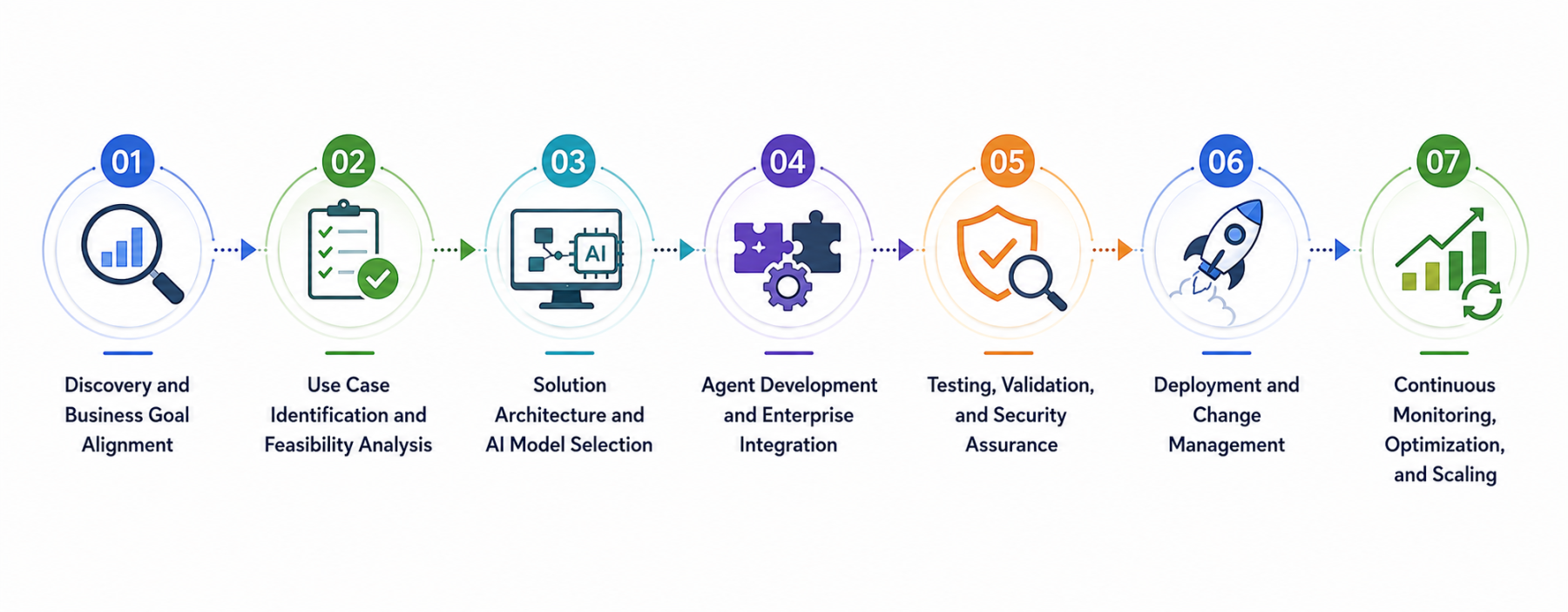
Building a production-ready AI agent follows a structured process. Skipping steps here is usually where projects run into scalability, security, or accuracy problems later.
Step 1: Discovery and Business Goal Alignment
Every successful project starts by identifying the actual business problem, not the technology. This phase involves talking to stakeholders, mapping pain points, and defining clear success metrics, such as reduced handling time or improved accuracy.
Step 2: Use Case Identification and Feasibility Analysis
Not every workflow is a good fit for automation. This step evaluates which processes offer the highest impact and are technically achievable given current data quality, system access, and organizational readiness.
Step 3: Solution Architecture and AI Model Selection
Here, teams design the agent's technical foundation - selecting the right LLM, memory architecture, and orchestration approach. Decisions made in this step determine how well the agent scales and how securely it handles sensitive enterprise data.
Step 4: Agent Development and Enterprise Integration
This is where the agent is actually built and connected to enterprise systems - CRM, ERP, ticketing platforms, and internal knowledge bases. Strong integration enables an agent to move beyond answering questions and begin completing real tasks, such as feeding insights into a Business Intelligence dashboard.
Step 5: Testing, Validation, and Security Assurance
Before deployment, the agent undergoes functional testing, accuracy validation, and security review. This includes stress-testing edge cases, checking for data leakage risks, and confirming the agent behaves predictably under unexpected inputs.
Step 6: Deployment and Change Management
A successful launch isn't just technical - it requires training staff, setting expectations, and rolling out the agent in phases. Change management at this stage significantly reduces resistance and friction in adoption.
Step 7: Continuous Monitoring, Optimization, and Scaling
Once live, the agent needs ongoing monitoring for performance drift, user feedback loops, and periodic retraining. Over time, successful agents expand from a single use case to multiple departments, such as extending an internal support agent to also power IT Helpdesk automation.

Turn Your AI Vision into Reality
Building a reliable, enterprise-grade AI agent takes more than a great model - it takes the right architecture, integrations, and security from day one. TechWize helps you get there faster, with a team that has done it before.
Talk to Our AI ExpertsBest AI Frameworks for Enterprise AI Agent Development
Choosing the right framework depends on your orchestration needs, existing tech stack, and scalability goals. Some of the most widely used options in 2026 include:
- LangChain and LangGraph - popular for building multi-step, stateful agent workflows with strong community support
- CrewAI - designed for coordinating multiple specialized agents working together on complex tasks
- Microsoft Semantic Kernel - a strong fit for enterprises already embedded in the Microsoft ecosystem
- AutoGen - useful for building conversational, multi-agent systems that collaborate on problem-solving
- LlamaIndex - purpose-built for connecting agents to enterprise data through retrieval-augmented generation
- Native provider SDKs, such as the Claude Agent SDK and OpenAI's Agents SDK, offer tighter integration with a specific model provider's tool-calling and reasoning capabilities
Most enterprises end up combining two or more of these frameworks depending on the complexity of their workflows and the systems they need to integrate with.
TechWize: Turn Your AI Vision into Reality with an AI Agent Development Company
Even with the right process and frameworks in place, building enterprise-grade AI agents in-house is resource-intensive. This is where working with an experienced AI Agent Development Company makes a measurable difference.
TechWize specializes in designing and delivering Custom AI Agent Development solutions built around each client's specific workflows, data environment, and compliance requirements. From initial discovery through architecture, integration, testing, and long-term optimization, our team combines deep technical expertise with enterprise-grade security practices to help organizations move from AI experimentation to reliable, scalable deployment. Whether the goal is to automate internal support, enhance decision-making through data-driven insights, or build a fully custom enterprise assistant, TechWize provides the end-to-end expertise needed to turn an AI vision into a working, production-ready system.
Read Similar Blog
How to Hire the Right AI Implementation Consultant for Measurable Business Growth
Explore More AI Insights ⬩➤Conclusion: Take the Next Step in Enterprise AI Agent Development
The shift from experimenting with AI chatbots to deploying full-scale enterprise AI agents is no longer a future trend - it's happening now. Organizations that succeed will be those that treat AI Agent Development as a structured discipline: grounded in clear business goals, built on secure, scalable architecture, and supported by continuous optimization rather than a one-time launch.
If your organization is ready to move beyond pilots and build an AI agent that delivers real business results, the next step is to partner with a team that has done it before. Reach out to TechWize to start scoping your Enterprise AI Agent Development roadmap today.