501, Fifth Avenue, Suite 805 New York, NY 10017
 info@techwize.com
 +1 (949) 887-0154
 TechWize

Operational complexity is no longer a back-office problem. It shows up on the shop floor, in the warehouse, on the customer service line, and in every late shipment or missed reorder point. As manufacturers and distributors scale across locations, currencies, and entities, disconnected systems turn small inefficiencies into real revenue leaks. This is why digital transformation has moved from a competitive advantage to a survival requirement, and why more mid-market and enterprise organizations are turning to a proven, purpose-built platform: Sage X3.
A well-planned Sage X3 Implementation gives manufacturers and distributors a single source of truth across production, inventory, finance, and supply chain. But the platform is only half the story. The other half is execution - choosing the right implementation partner, the right rollout strategy, and the right long-term roadmap. In this article, we will break down why Sage X3 is so well-suited for manufacturing and distribution, what core capabilities drive real growth, and how the right Sage X3 Implementation Services provider can turn a software rollout into a lasting operational advantage.
Why Manufacturers and Distributors Need a Connected ERP System
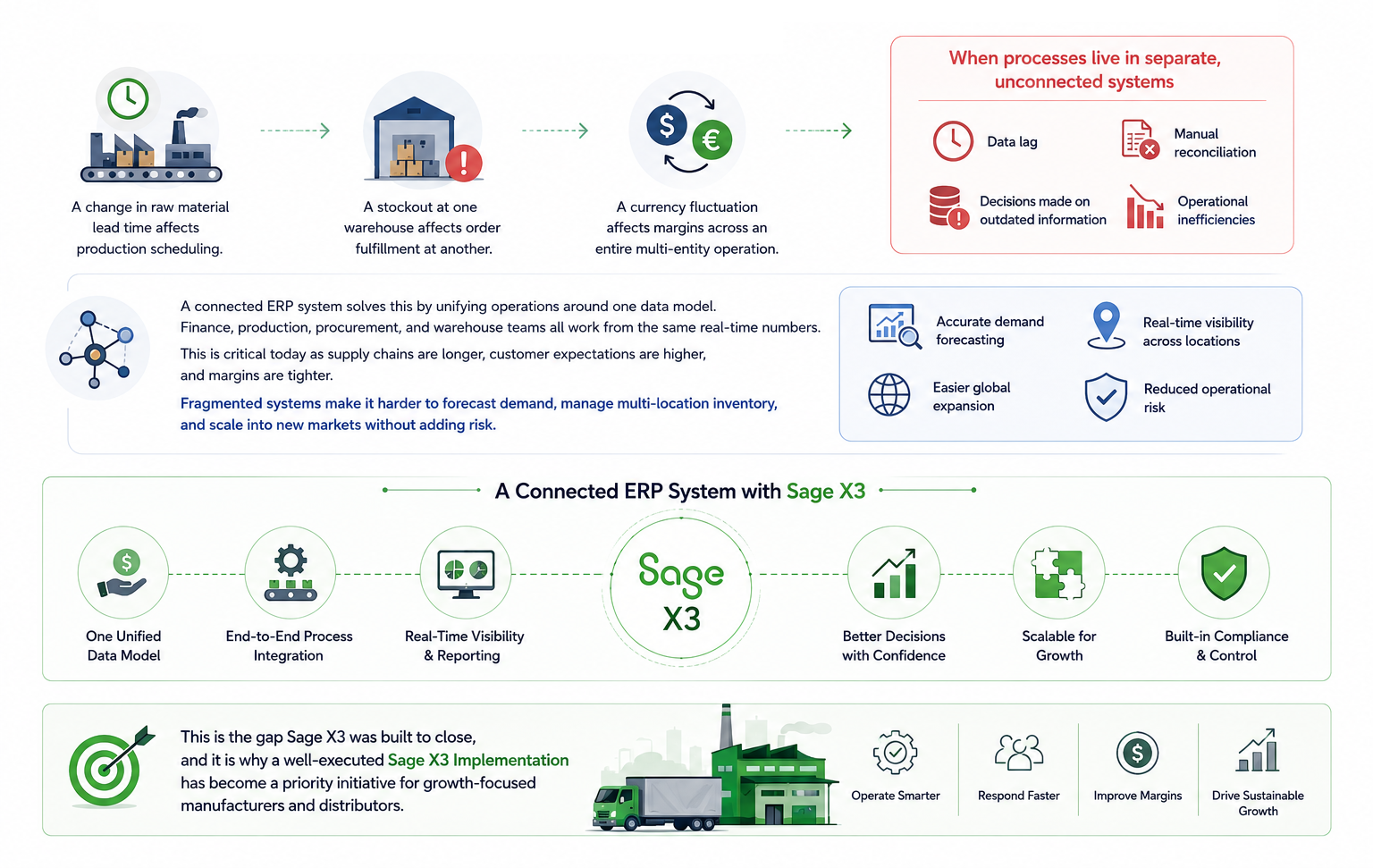
Manufacturing and distribution businesses run on interdependent processes. A change in raw material lead time affects production scheduling. A stockout at one warehouse affects order fulfillment at another. Currency fluctuations affect margins across an entire multi-entity operation. When these processes live in separate, unconnected systems - spreadsheets, legacy ERP, disconnected point solutions - the result is data lag, manual reconciliation, and decisions made on outdated information.
A connected ERP system solves this by unifying operations around one data model. Instead of finance, production, procurement, and warehouse teams each working from their own version of the truth, everyone works from the same real-time numbers. This matters more today than ever, as supply chains have grown longer, customer expectations have tightened, and margins have narrowed. Businesses that still rely on fragmented systems are finding it increasingly difficult to forecast demand accurately, manage multi-location inventory, or scale into new markets without adding operational risk.
This is the gap Sage X3 was built to close, and it is why a well-executed Sage X3 Implementation has become a priority initiative for growth-focused manufacturers and distributors.
What Makes Sage X3 Implementation the Right Fit for Manufacturing and Distribution
Sage X3 was designed from the ground up for process-intensive industries, not adapted from a generic financial system. That distinction matters. Manufacturing and distribution companies need an ERP that understands production routings, bills of materials, lot and serial traceability, multi-warehouse logistics, and complex costing models - not a system that treats these as add-ons.
A properly scoped Sage X3 Implementation gives businesses:
- A unified platform for finance, inventory, production, and sales
- Flexibility to configure workflows around actual business processes rather than forcing processes into rigid software
- Scalability to support multiple sites, subsidiaries, and currencies without needing separate systems
- Faster, more accurate reporting through real-time data instead of end-of-month reconciliation
Because Sage X3 is built with configurability at its core, implementation teams can tailor the platform to match how a specific manufacturer or distributor actually operates, rather than requiring the business to change its processes to fit the software. This is one of the biggest reasons Sage X3 outperforms more rigid, generic ERP platforms in process-driven industries.
Core Capabilities of Sage X3 Implementation for Manufacturing and Distribution Growth
A successful rollout is built on capabilities that directly address the daily pain points of manufacturing and distribution operations.
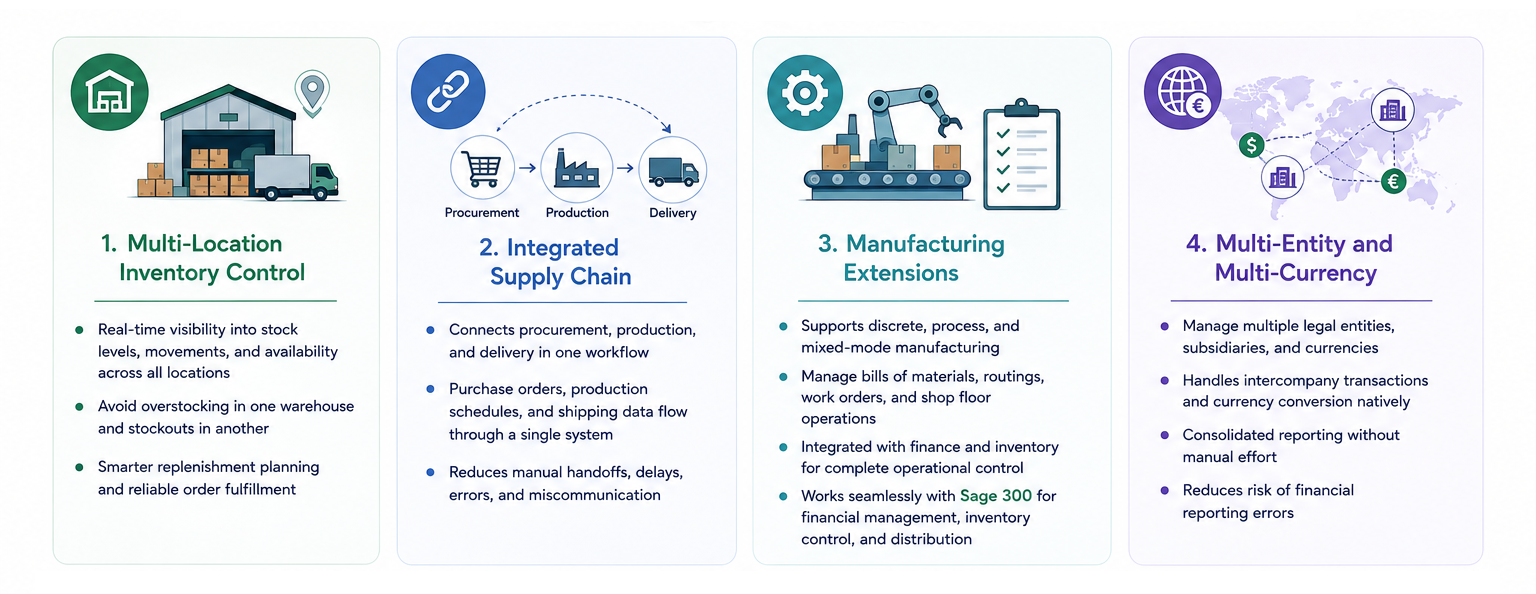
Multi-Location Inventory Control
Businesses operating across multiple warehouses or distribution centers need real-time visibility into stock levels, movements, and availability at every location. Sage X3 provides centralized inventory control with location-specific detail, helping teams avoid overstocking in one warehouse while facing stockouts in another. This visibility supports smarter replenishment planning and more reliable order fulfillment.
Integrated Supply Chain
From procurement to production to delivery, Sage X3 connects every stage of the supply chain into a single workflow. Purchase orders, production schedules, and shipping data flow through a single system, reducing manual handoffs that typically cause delays, errors, and miscommunication between departments.
Manufacturing Extensions
Sage X3 supports discrete, process, and mixed-mode manufacturing environments, while Sage 300 provides robust financial management, inventory control, and distribution capabilities for growing businesses. Together, they help organizations manage bills of materials, routings, work orders, shop floor operations, finance, and inventory within an integrated ERP ecosystem. This unified approach gives production and finance teams the tools they need without relying on disconnected systems, improving visibility, efficiency, and operational control.
Multi-Entity and Multi-Currency
Growing manufacturers and distributors often operate across multiple legal entities, subsidiaries, and currencies. Sage X3 handles intercompany transactions, currency conversion, and consolidated reporting natively, eliminating the need for manual consolidation and reducing the risk of financial reporting errors.
Together, these capabilities make Sage X3 a strong long-term fit for organizations that expect to keep growing, not just organizations solving today's problems.
The Role of Sage X3 Integration Services in Building a Connected Operation
Implementing Sage X3 is a major step forward, but most manufacturers and distributors do not operate in a single-system environment. CRM platforms, e-commerce storefronts, EDI networks, warehouse management systems, and third-party logistics providers often need to communicate directly with the ERP.
This is where Sage X3 Integration Services become essential. Proper integration ensures that data moves automatically and accurately between Sage X3 and the other systems a business depends on, eliminating duplicate data entry and reducing the risk of errors that come from manually transferring information between platforms.
Strong integration work typically covers:
- API-based connections between Sage X3 and CRM, e-commerce, or WMS platforms
- EDI integration for seamless order processing with trading partners
- Middleware configuration to support real-time or scheduled data synchronization
- Custom integration development for industry-specific tools
Without well-planned Sage X3 Integration Services, even a strong ERP implementation can end up siloed from the rest of the technology stack, limiting the very efficiency gains the project was meant to deliver.
Choosing the Right Sage X3 Implementation Solution for Your Business
Not every Sage X3 Implementation Solution looks the same, and that is by design. A make-to-stock manufacturer has different needs than a make-to-order or engineer-to-order operation. A regional distributor has different requirements than a multi-entity organization operating across borders.
Choosing the right solution starts with an honest assessment of current processes, pain points, and growth plans. From there, the implementation should be scoped around:
- Which modules are needed now versus which can be phased in later
- How existing data will be migrated and validated
- What level of customization is genuinely necessary versus what can be handled through configuration
- How the system will need to scale over the next three to five years
A rushed or generic implementation often leads to underused features, workarounds that recreate old inefficiencies, and a system that never fully delivers on its potential. A thoughtfully scoped Sage X3 Implementation Solution, by contrast, is built around how the business actually operates and how it plans to grow.
Why Choosing the Right Sage X3 Implementation Provider Matters
The platform is only as strong as the team implementing it. Sage X3 offers deep configurability, a major advantage, but it also means implementation quality varies significantly among providers. The right partner brings industry-specific experience, not just general ERP knowledge.
Key factors to evaluate in a Sage X3 Implementation Provider include:
- Proven experience in manufacturing and distribution specifically, not just ERP in general
- A structured implementation methodology with clear milestones and accountability
- In-house expertise in both implementation and integration, so the two are not handled as disconnected workstreams
- Post-go-live support capabilities, including training, optimization, and ongoing enhancements
A provider with hands-on manufacturing and distribution experience will understand nuances like lot traceability requirements, multi-warehouse replenishment logic, and industry-specific compliance needs, which translates into fewer surprises during rollout and a system that performs as expected from day one.

Accelerate Manufacturing Growth with Sage X3 Implementation
Streamline operations, improve inventory visibility, and connect your manufacturing and distribution processes with a tailored Sage X3 implementation from TechWize.
Schedule a Sage X3 ConsultationFuture-Proofing Growth: Next-Gen Sage X3 Implementation Ecosystem and Roadmap
Choosing Sage X3 is not just a decision for today's operations. Sage continues to invest in the platform's ecosystem, and understanding that roadmap helps businesses plan implementations that stay relevant for years to come.
Receivables and Payables
Ongoing enhancements to receivables and payables functionality in Sage X3 are streamlining cash flow management, automating reconciliations, and reducing manual effort in financial close processes. Organizations using Sage 200 can also benefit from strong financial management capabilities, making it a suitable option for businesses with less complex operational requirements.
Web Screen Ecosystem
Sage X3's modern web screen framework continues to expand, giving users a more intuitive, browser-based experience across devices while reducing dependency on older client interfaces.
Warehouse and Inventory Compliance
As regulatory and traceability requirements increase across industries, Sage X3 continues to strengthen its warehouse and inventory compliance features, supporting lot and serial tracking and audit-ready reporting.
Technology Roadmap
Sage's broader technology roadmap emphasizes cloud flexibility, API-first architecture, and deeper analytics capabilities, positioning Sage X3 to keep pace with evolving manufacturing and distribution technology needs rather than becoming outdated.
Businesses that plan their implementation with this roadmap in mind position themselves to adopt new capabilities as they are released, rather than requiring a disruptive re-platforming effort down the line.
TechWize: Drive Manufacturing Success with Our Sage X3 Implementation Services
At TechWize, manufacturing and distribution success is not an abstract goal - it is the standard every engagement is measured against. Our team combines deep Sage X3 platform expertise with real-world industry experience, giving clients an implementation partner that understands both the software and the operational realities of running a manufacturing or distribution business.
Our Sage X3 Implementation Services are built around a structured, low-risk methodology that covers process discovery, data migration, configuration, testing, training, and go-live support. We do not treat implementation and integration as separate conversations. Our Sage X3 Integration Services are designed alongside the core implementation, ensuring your ERP connects seamlessly with your CRM, e-commerce, WMS, and EDI networks from day one, rather than being addressed as an afterthought.
Because every business is different, we do not offer a one-size-fits-all Sage X3 Implementation Solution. Instead, we scope every engagement around your specific manufacturing model, growth plans, and existing technology environment, so the system you end up with actually reflects how your business runs, not a generic template. From initial assessment through post-go-live optimization, TechWize acts as a long-term partner, not just a vendor completing a project, helping you get sustained value from Sage X3 well beyond the initial rollout.
Read Similar Blog

The Ultimate Sage X3 Implementation and Optimization Guide for 2026
Explore More Sage X3 Insights ⬩➤Conclusion: Unlock the Full Potential of the Sage X3 Solution
Manufacturing and distribution businesses cannot afford disconnected systems in an environment defined by tighter margins, higher customer expectations, and increasingly complex supply chains. Sage X3 offers the depth, flexibility, and scalability these industries need, but the platform delivers real value only when implemented and integrated correctly.
A well-planned Sage X3 Implementation, backed by strong Sage X3 Integration Services and a clearly defined Sage X3 Implementation Solution, gives manufacturers and distributors the connected operational foundation they need to grow with confidence. The right implementation partner makes the difference between a system that simply runs and one that actively drives growth.
If your organization is ready to unlock the full potential of Sage X3, partnering with a team that understands both the platform and your industry is the most important decision you will make.