501, Fifth Avenue, Suite 805 New York, NY 10017
 info@techwize.com
 +1 (949) 887-0154
 TechWize

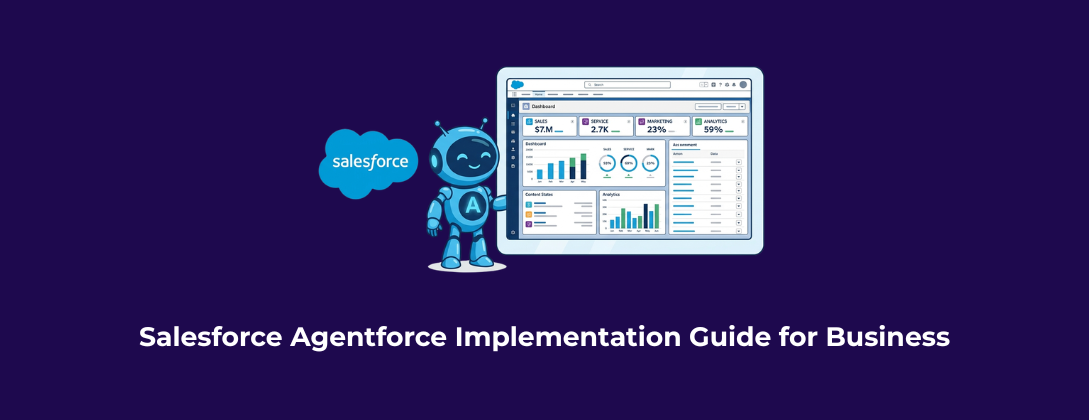
For years, businesses relied on chatbots to handle repetitive customer interactions. These systems followed predefined scripts, responded to keywords, and operated within strict boundaries. While useful, they often failed when conversations became complex or required contextual understanding.
Today, a fundamental shift is underway. Enterprises are moving from reactive chatbots to proactive, autonomous AI agents. These agents do not just respond. They reason, plan, and execute tasks across systems with minimal human intervention.
This evolution is driven by the need for speed, personalization, and operational efficiency. Customers expect instant and accurate responses. Employees demand tools that reduce manual work. Businesses seek scalable solutions that deliver measurable outcomes.
This is where Salesforce Agentforce Implementation Services come into play, enabling organizations to deploy intelligent agents that act as digital coworkers rather than simple tools.
Key Metrics to Measure Your ROI Effectively
Implementing autonomous agents is not just a technology decision. It is a business investment. Measuring success requires a clear focus on outcomes rather than activity.
Industry benchmarks suggest that organizations adopting AI-driven automation often see significant improvements in operational efficiency and customer satisfaction. However, the real value lies in tracking the right metrics.
Start with resolution time. Autonomous agents reduce average handling time by automating multi-step workflows. Then evaluate first-contact resolution rates, which indicate how effectively agents solve issues without escalation.
Cost per interaction is another critical factor. When agents handle repetitive tasks, human resources can shift to higher-value activities. This leads to a noticeable reduction in operational costs.
Revenue impact should not be overlooked. Intelligent agents can assist in upselling, cross-selling, and lead qualification, directly influencing top-line growth.
Finally, track user satisfaction. Whether it is customer experience or employee productivity, improved satisfaction is often the clearest indicator of successful implementation.
What is Salesforce Agentforce? Understanding the New Era of AI
Salesforce Agentforce represents a new category of enterprise AI. It combines large language models, real-time data, and workflow automation to create autonomous agents capable of executing business tasks.
Unlike traditional AI tools, Agentforce operates with intent awareness. It understands context, retrieves relevant data, and takes action across multiple systems. This makes it suitable for complex enterprise environments where decisions require both intelligence and execution.
At its core, Agentforce transforms AI from a support tool into an operational layer within the organization. It integrates deeply with CRM, service platforms, and data ecosystems, allowing businesses to unify customer interactions and backend processes.
Organizations leveraging Salesforce ERP Services can move beyond automation and into true orchestration, where AI agents manage workflows end-to-end.
The Core Components of the Salesforce Agentforce Ecosystem
Understanding the ecosystem is essential for successful implementation. Agentforce is not a single tool. It is a combination of interconnected components that work together to deliver intelligence and action.
The first component is the reasoning engine. This is where the agent interprets user intent, evaluates possible actions, and decides the next step. It moves beyond rule-based logic into dynamic decision-making.
Next is the data layer. Unified data is critical for accurate responses. Agentforce leverages Data Cloud to bring together structured and unstructured data from across the enterprise. The action framework enables agents to execute tasks. This includes updating records, triggering workflows, and interacting with external systems through APIs.
Finally, the experience layer ensures that interactions are natural and contextual. Whether through chat, voice, or embedded interfaces, the agent communicates in a human-like manner.
Why Your Business Needs Salesforce Agentforce Implementation
The modern enterprise operates in an environment of constant change. Customer expectations are rising. Operational complexity is increasing. Traditional systems struggle to keep up.
Autonomous agents address these challenges by acting as scalable digital labour. They handle repetitive processes, assist in decision-making, and ensure consistency across operations. Businesses that adopt Agentforce gain a competitive advantage through faster response times, improved accuracy, and enhanced customer engagement.
Moreover, the ability to integrate across systems eliminates data silos. This leads to better insights and more informed decisions.
Investing in Salesforce Agentforce Consulting ensures that implementation aligns with business goals, rather than becoming just another technology deployment. Combined with Salesforce Marketing Cloud Services, it creates a unified framework where AI-driven insights, customer data, and personalized engagement strategies work together to deliver greater efficiency, stronger customer retention, and more impactful marketing performance.
The Strategic Roadmap: A Step-by-Step Salesforce Agentforce Implementation Guide
Successful implementation requires a structured approach. Organizations must align strategy, data, and technology to achieve meaningful results.
Phase 1: Discovery and Use Case Definition
Every implementation begins with clarity. Identify high-impact use cases where automation can deliver immediate value.
Focus on areas such as customer support, sales assistance, or internal operations. Evaluate processes that are repetitive, time-consuming, or prone to errors.
Define success metrics early. This ensures that outcomes can be measured and optimized over time.
Phase 2: Data Readiness and The Data Cloud Connection
Data is the foundation of intelligent agents. Without clean and unified data, even the most advanced AI will fail.
This phase involves integrating data sources, ensuring quality, and establishing governance frameworks. Data Cloud plays a critical role in consolidating information from multiple systems.
Organizations often underestimate this step. However, it is the most important factor in determining the effectiveness of autonomous agents.
Phase 3: Designing Topics and Actions
This is where the agent comes to life. Define the scope of interactions, known as topics, and map them to specific actions.
Topics represent user intents, while actions define what the agent can do. This includes retrieving data, updating records, or triggering workflows.
Design should focus on flexibility. Agents must handle variations in user input while maintaining accuracy and consistency.
Phase 4: Testing, Training, and Iteration
Deployment is not the end. It is the beginning of continuous improvement.
Test the agent across different scenarios to ensure reliability. Train it using real-world data to improve accuracy.
Iteration is key. Monitor performance, gather feedback, and refine the system regularly. Over time, the agent becomes more intelligent and effective.
The Role of Salesforce Agentforce Consulting in Successful Deployment
Implementing autonomous AI is complex. It requires expertise in technology, data, and business processes.
Consulting plays a critical role in bridging this gap. Experienced consultants help define strategy, design architecture, and ensure seamless integration.
They also provide guidance on governance, security, and compliance, which are essential in enterprise environments.
Organizations leveraging Salesforce Agentforce Implementation Services with expert consulting support are more likely to achieve faster adoption and better outcomes.
Technical Architecture Leveraging Salesforce Agentforce Cloud Services
The architecture of Agentforce is designed for scalability and flexibility. At the base is the data layer, powered by Data Cloud. This ensures real-time access to unified data.
Above this sits the AI layer, which includes language models and reasoning engines. These components enable understanding and decision-making. The integration layer connects the agent to enterprise systems such as CRM, ERP, and external applications. APIs and connectors facilitate seamless communication.
Finally, the experience layer delivers interactions through multiple channels, ensuring a consistent user experience. This modular architecture allows businesses to scale gradually, adding capabilities as needed.
Real World Use Cases: Salesforce Agentforce Across Industries
The versatility of Agentforce makes it applicable across industries. In retail, agents assist customers with product recommendations, order tracking, and returns. This improves customer satisfaction while reducing support costs.
In healthcare, they streamline patient interactions, manage appointments, and provide information, enhancing both efficiency and patient experience. Financial services organizations use agents for fraud detection, customer onboarding, and personalized advisory services.
Manufacturing companies leverage them for supply chain optimization, predictive maintenance, and vendor management. Across all these industries, the common theme is efficiency, accuracy, and scalability.
Overcoming Common Challenges During Salesforce Agentforce Implementation
Despite its benefits, implementation comes with challenges. Data fragmentation is a major issue. Without proper integration, agents cannot function effectively.
Change management is another critical factor. Employees may resist adopting new technologies, especially when they fear job displacement. There are also concerns around accuracy and trust. Businesses must ensure that agents provide reliable and compliant responses.
Addressing these challenges requires a combination of strong leadership, clear communication, and robust technical frameworks.
The Future of Work Scaling with Salesforce Agentforce Cloud Services
The concept of digital labor is redefining how work gets done. Autonomous agents are not replacing humans. They are augmenting them. By handling repetitive tasks, they free up human resources for strategic and creative work.
As technology evolves, agents will become more sophisticated. They will collaborate with humans, learn from interactions, and continuously improve. Organizations that embrace this shift early will be better positioned to scale and innovate.
Partnering with TechWize for Salesforce Agentforce Success
Choosing the right partner can make a significant difference in the success of your implementation.
TechWize brings a combination of technical expertise, industry knowledge, and practical experience. Their approach focuses on aligning technology with business outcomes, ensuring that every implementation delivers measurable value.
From strategy to execution, they support organizations at every stage of the journey, helping them unlock the full potential of autonomous AI.
Conclusion: Transforming Business with Digital Labor
The transition from chatbots to autonomous agents marks a defining moment in enterprise technology. Businesses are no longer limited to reactive systems—they now have the ability to deploy intelligent agents that think, act, and deliver measurable results.
Organizations looking to extend these capabilities can also leverage Sales Cloud (Agentforce Sales) to streamline sales operations and drive smarter pipeline management.
On the customer engagement side, Marketing Cloud enables businesses to deliver highly personalized, data-driven experiences across every touchpoint.
Success depends on a clear strategy, a strong data foundation, and continuous optimization. With the right approach, organizations can achieve significant improvements in efficiency, customer experience, and growth. Partnering with experienced providers like TechWize ensures that this transformation is not only successful but also sustainable—enabling businesses to thrive in the era of digital labor.