501, Fifth Avenue, Suite 805 New York, NY 10017
 info@techwize.com
 +1 (949) 887-0154
 TechWize

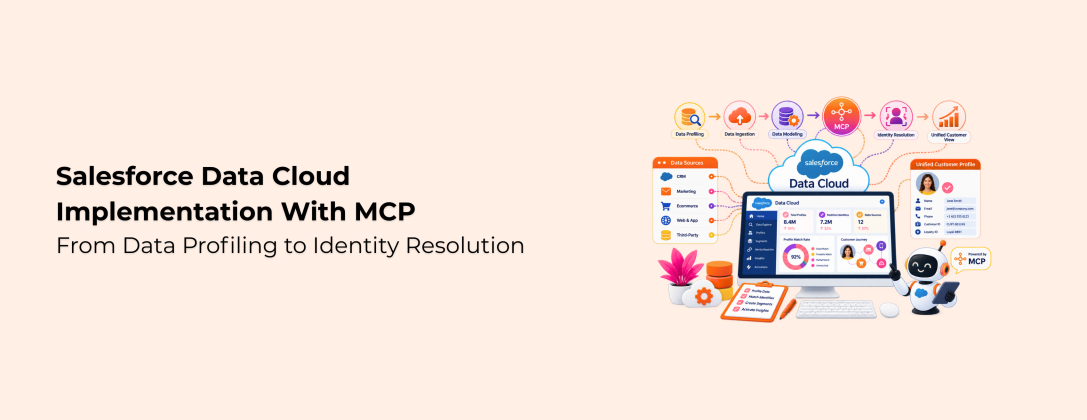
Most conversations about AI and Salesforce Data Cloud implementation remain at the theoretical level, with proof-of-concept demos, vendor slide decks, and cautious optimism about "what's coming." A recent hands-on experiment changed that conversation by testing whether an agentic workflow, built on Claude Code and the Model Context Protocol (MCP), could handle a real-world identity-resolution build for the CRM Contact object end-to-end (source: Mehmet Orun).
The results were not a flawless success story, and that is precisely what makes them worth studying. The design and reasoning work were performed at a level that would normally take a consulting team days to complete. The API layer, still maturing, pushed back in ways that revealed exactly where the platform needs to catch up. For any team evaluating a Salesforce Data Cloud implementation or a broader Salesforce Data 360 implementation, this kind of transparent field test is more valuable than another polished case study.
Why This Salesforce Data 360 Implementation Test Mattered
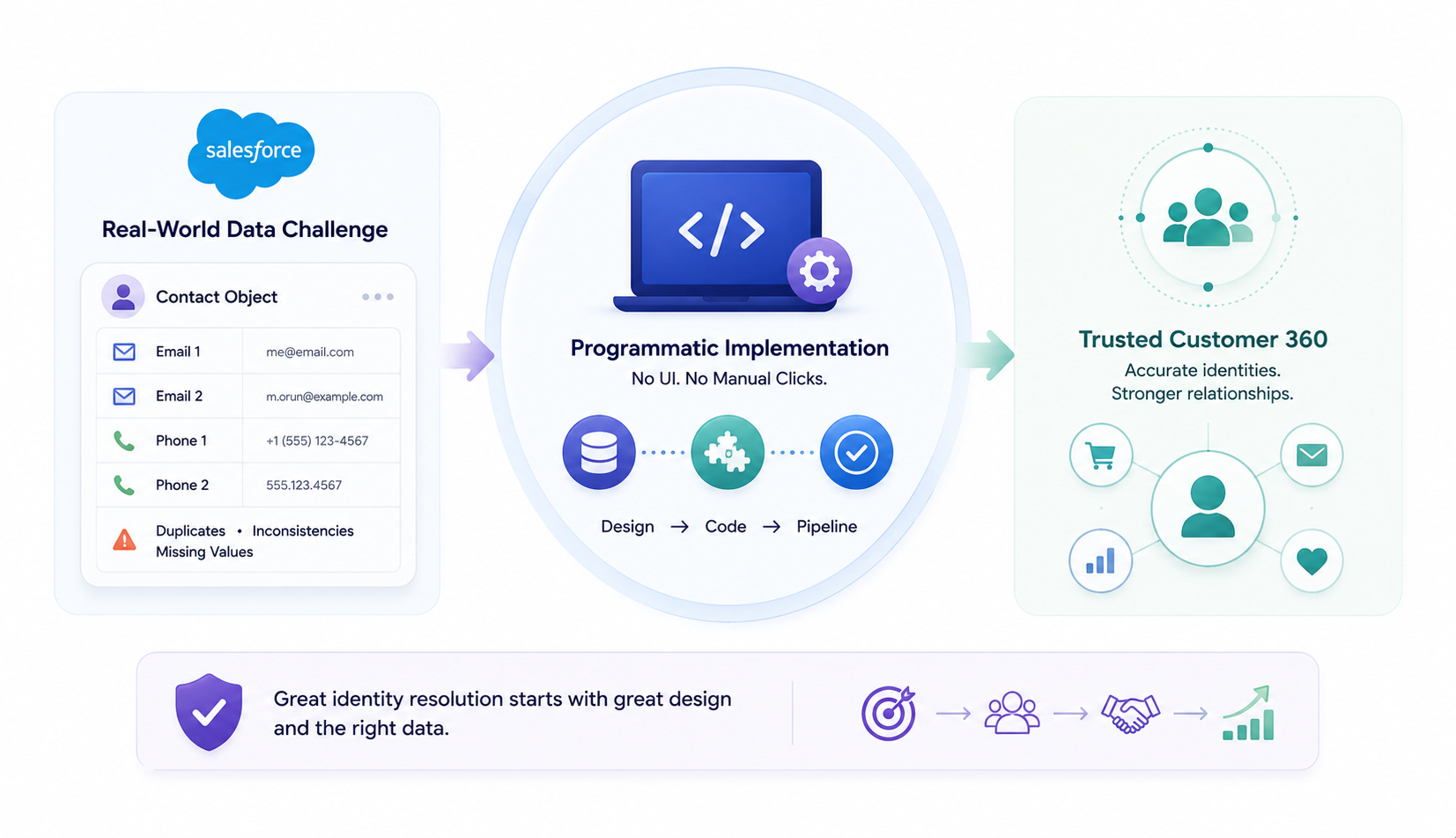
The experiment deliberately avoided the path of least resistance. Instead of a toy dataset, the test used the Contact object with a realistically messy schema, multiple email and phone fields, and the kinds of data quality issues every Salesforce architect has encountered in production orgs (source: Mehmet Orun).
The objective was an ambitious design and to begin configuring a complete identity resolution pipeline programmatically, without touching the Data Cloud user interface, using an authoritative design document as the source of truth. That single constraint - no UI, no manual clicking through setup screens - is what separates this from a typical implementation walkthrough. It tested whether underlying architectural decisions, the kind that usually require multiple stakeholder meetings and spreadsheet reviews, could be reasoned through conversationally and then implemented in code (source: Mehmet Orun).
This matters because identity resolution design is often the most underestimated part of any Salesforce Cloud implementation. Get the field selection wrong, and downstream matching rules produce false positives that erode trust in the entire Customer 360 initiative.
Salesforce Data Cloud MCP Environment Setup: A Step-by-Step Implementation Guide
Before any design work could begin, a working environment had to be set up. The setup involved installing Claude Code through the standard CLI path, cloning the Data 360 MCP server, and installing its dependencies through Maven. Credentials came next: a connected app in Salesforce, a private key for JWT authentication, and a configuration file pointing Claude Code to the MCP server. A simple metadata query confirmed the connection was live (source: Mehmet Orun).
The entire process took under 30 minutes. That speed is notable given the person running it was an experienced data architect, not a full-time developer, a reminder that Salesforce Data Cloud MCP setups are becoming accessible to a wider range of practitioners, not just engineering specialists (source: Mehmet Orun).
Step 1 - Profiling Data Before Touching Configuration
Rather than jumping straight into mapping fields, the first move was analytical. Existing data profiling results - field-level fill rates, dominant value distributions, and quality signals - were pulled directly through the MCP interface from a managed package data profiling tool already integrated with Data Cloud (source: Mehmet Orun).
From there, a structured two-gate evaluation framework was applied to every candidate field being considered for identity resolution matching:
- Semantic gate: Does the field genuinely belong to the individual, or does it actually describe a role, a relationship, or an organization?
- Quantitative gate: Is the underlying data clean enough to use in matching logic, or do outliers risk producing false positive matches?
This two-gate approach produced a systematic, field-by-field evaluation across every identity resolution candidate in the Contact object, which is the kind of rigour that is easy to skip under project timeline pressure but expensive to skip in production (source: Mehmet Orun).
Step 2 - Documenting Identity Resolution Decisions for Traceability
Every serious Salesforce Data Cloud implementation needs a paper trail showing who decided what and on what evidence. The next step generated design artefacts covering two critical decisions - which fields belonged in identity resolution match rules and why, and whether source Contact data could map directly to target Data Model Objects (DMOs) or needed transformation first (source: Mehmet Orun).
The conclusion was unambiguous. Three of the four target DMOs required an interim transformation layer before Contact data could be mapped. Two issues drove that call. First, a normalization requirement: a single Contact record holds multiple email addresses and multiple phone numbers across separate fields, while the canonical Data Cloud model expects one row per contact point - a shape mismatch that mapping alone cannot solve. Second, outlier filtering: profiling had already flagged a meaningful share of records using placeholder email values, the kind of data that looks legitimate but generates false positive matches if it reaches identity resolution unfiltered (source: Mehmet Orun).
None of this was a surprising conclusion to an experienced architect. What changed was the speed and consistency with which the reasoning was documented in a shareable format - something that rarely emerges naturally from working inside the Data Cloud UI.
Step 3 - Creating Interim Data Lake Objects (DLOs)
With the design decisions reviewed and confirmed, implementation began. Three interim Data Lake Objects were created through the MCP interface - one each for email, phone, and address contact points - each mirroring the schema of its target DMO to keep the eventual mapping straightforward. All three came back active within a short window, and this part of the process worked exactly as expected (source: Mehmet Orun).
This is also where organizations running parallel Salesforce Sales Cloud instances tend to see the clearest payoff of a clean, well-structured DLO layer that keeps contact and account data consistent across every downstream system that depends on it, not just Data Cloud itself.
Step 4 - Designing Transformation Logic (and Where the Salesforce Data Cloud MCP Hit a Wall)
The transformation requirements were genuinely complex: fan-out logic to convert a single Contact row into multiple output rows per email or phone type, each with a unique composite key; filtering logic to strip placeholder values before they reached identity resolution; and normalization logic to standardize casing, whitespace, and country name variants (source: Mehmet Orun).
The transformation logic itself was designed successfully and tied directly back to the profiling findings from Step 1. The failure came when attempting to create those transforms through the Batch Data Transform API. Eight distinct payload variants were attempted - flat structures, nested structures, every type identifier the API's own error messages suggested was valid - and all eight failed, some with HTTP 400 errors, some with opaque HTTP 500 server exceptions (source: Mehmet Orun).
The most revealing failure came when the API's validation layer named two supposedly valid definition type identifiers in an error message, only for the deserializer to reject those same identifiers as unresolvable. That is not a user configuration mistake. It is a platform-level inconsistency between two internal systems that are supposed to agree with each other (source: Mehmet Orun).
How Salesforce Data Cloud MCP Turned an API Blocker Into a Structured Bug Report
Instead of treating the failure as a dead end, the blocker became a formal API usability bug report. The report included full environment context, all eight payload attempts with exact requests and responses, an expected-versus-actual behavior comparison, a root cause hypothesis pointing to the mismatch between the validation layer's type registry and the deserializer's type registry, and the business impact of the blocker (source: Mehmet Orun).
That level of detail changed the outcome. Once shared with the product owner responsible for the feature, the issue was diagnosed and escalated internally within hours - a sharp contrast to the vague "the API isn't working" reports that often stall in support queues for weeks (source: Mehmet Orun).

Accelerate Your Salesforce Data Cloud Implementation
From data profiling to identity resolution, TechWize helps businesses build reliable Salesforce Data Cloud and Data 360 solutions with MCP-enabled workflows.
Talk to Salesforce Data Cloud ExpertsSalesforce Data Cloud Implementation: Key Lessons From a Real-World MCP Project
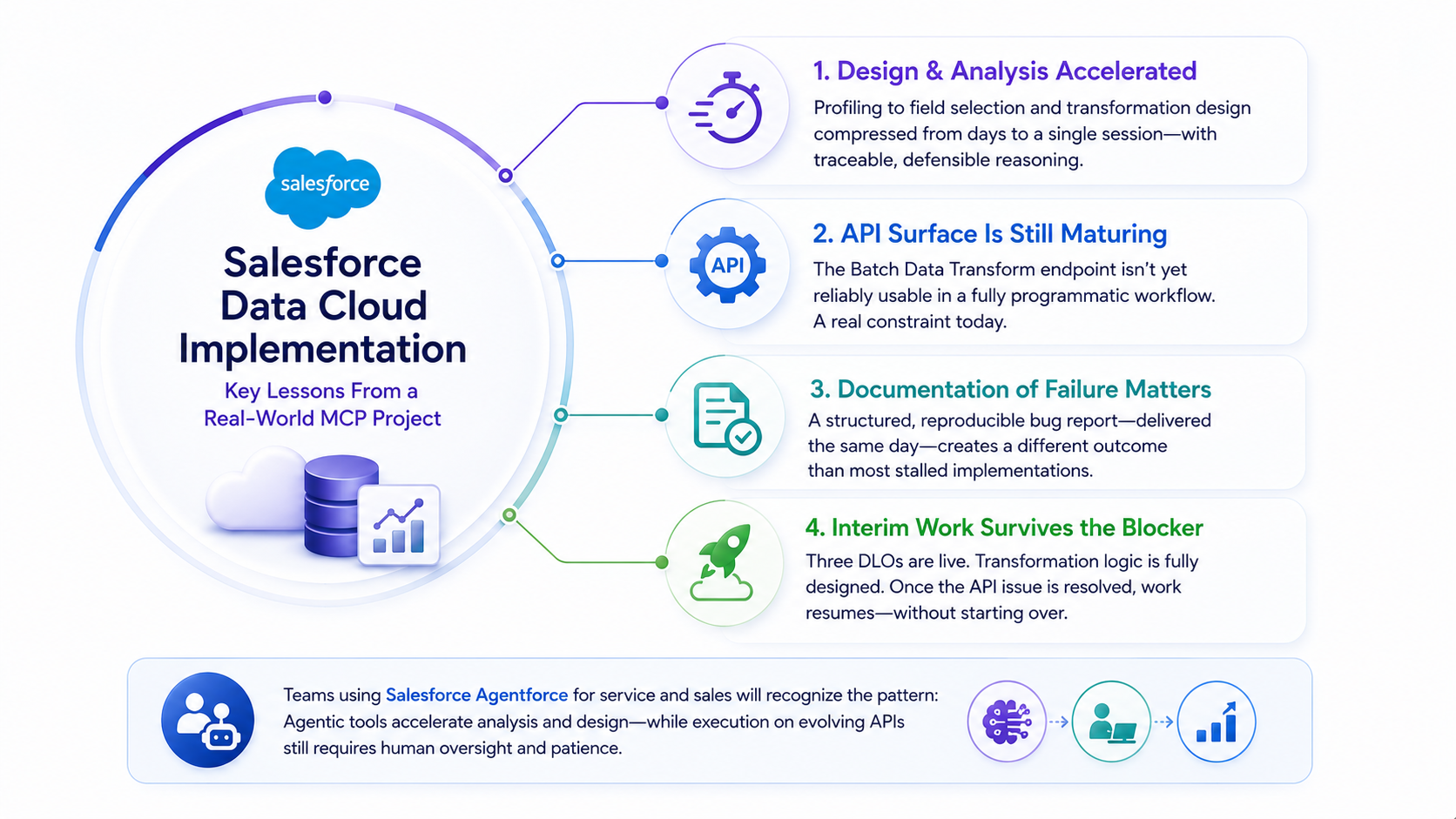
A few conclusions carry weight for any team weighing this approach:
- The design and analysis layer is genuinely accelerated. Turning profiling data into grounded, defensible field selection and transformation design compressed multi-day work into a single session, with traceable reasoning at every step.
- The API surface is still maturing. The Batch Data Transform endpoint is not yet reliably usable in a fully programmatic workflow. That is a real constraint today, not a permanent one.
- Documentation of failure has its own value. A structured, reproducible bug report, delivered the same day the issue surfaced, is a different category of outcome than most teams get from a stalled implementation.
- Interim work survives the blocker. The three DLOs are live and ready. The transformation logic is fully designed. Once the API issue is resolved, work resumes without having to start over.
Teams already running Salesforce Agentforce for service and sales use cases will recognise the pattern, and agentic tooling accelerates analysis and design dramatically, while execution against newer APIs still requires human oversight and patience as the platform matures.
TechWize: Trusted Salesforce Data Cloud and Data 360 Implementation Services
Field tests like this one make a broader point clear and getting real value from Salesforce Data Cloud implementation and Salesforce Data 360 implementation requires more than access to new tools. It requires teams who understand identity resolution design, DMO and DLO architecture, and transformation logic well enough to know when an agentic workflow is producing sound output and when a platform limitation needs to be worked around.
That is where TechWize fits in. Our team brings deep, hands-on experience across Salesforce Data Cloud and Salesforce Data 360 implementations, and the emerging world of Salesforce Data Cloud MCP tooling, combined with the underlying architectural discipline needed to make identity resolution, contact point mapping, and DMO design decisions that hold up in production. We also help organizations connect that unified data foundation to the systems that depend on it, including Salesforce Marketing Cloud campaigns that need clean, resolved customer identities to perform well.
If your organization is evaluating whether an agentic approach to Salesforce Data Cloud is worth adopting now, or you need an experienced partner to build a defensible identity resolution architecture the traditional way, TechWize can help you get there faster and with less rework.
Read Similar Blog
10 Must-Have Features of Salesforce Agentforce Revenue Management Cloud for Modern Businesses
Explore More Salesforce Insights ⬩➤Conclusion: The Future of Salesforce Data Cloud Implementation With MCP
This experiment is a useful, honest data point rather than a finished success story. The reasoning and design layer of Salesforce Data Cloud implementation is clearly ready for agentic acceleration today. The execution layer, at least for certain API endpoints, still needs the platform to catch up. Neither fact cancels out the other.
What is clear is that the interim data structures, the transformation design, and the decision trail all survived the blocker intact - proof that the design phase can be de-risked well ahead of a full rollout. As the API surface matures, expect this kind of workflow to become a standard part of how Salesforce Data Cloud and Data 360 projects get built, not a novelty worth a single blog post.